
Harvey O’Brien: Connemara Rambo
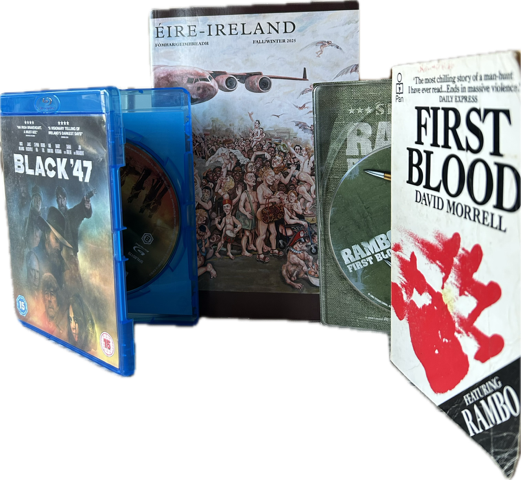
Black ’47 (Lance Daly, 2018, Ireland/Luxembourg) bore the weight of being the first internationally distributed Irish produced theatrical fictional feature film deploying The Great Famine as its setting. It was also a genre film – specifically an action movie depicting the vengeance trail of a former colonial soldier who returns to Ireland to a ravaged landscape steeped in death, deprivation, and injustice. But this wasn’t about historical redress for systemic underdevelopment and economic exploitation through grain export and insufficient administrative response to the crisis: this was personal… in the parlance of the genre. Black ‘47 is not an historical drama, nor is it a work of documentary. It is an action movie: a spectacular figuration of the fantasy of reconstitution of self and nation through the exercise of interpersonal violence. The broad strokes of the plot – a returning war veteran finds he has no real home to come back to and falls foul of local authorities when he lashes out after they push him – also describe the 1982 film First Blood (Ted Kotcheff, 1982, US) based on the 1972 novel by David Morell which introduced the name “Rambo” to the lexicon later describing unrestricted hypermasculine violence. The sequel to that film, Rambo: First Blood Part II (George P. Cosmatos, 1985, US) became an international cultural flashpoint in the culture wars of the Reagan era, as Time Magazine put it, treating live moral issues like live ammunition in politically destructive ways. Though Black ’47 didn’t generate the same level of international controversy as Rambo, reviews both within and outside of Ireland grappled with the paradox of such an historically significant setting and a film that was content to operate in the frame of genre. This paper argues that the historiographical instability created by genre film is not inherently destructive to historical discourse, be it the impact of The Great Famine or the Vietnam War (and the War at Home which followed and in which First Blood takes place). Both films exhibit and deploy genre tropes in an ideologically charged, historically problematic space, and situate dispute at the juncture between identity, trauma, and grievance
Background
The article, “Connemara Rambo: Genre Film and the Reconstitutive Vengeance Fantasy in Black ’47”, emerged out of teaching on the module FS21060 Action and Adventure Cinema in the UCD School of English, Drama and Film. The module in turn built upon my book Action Movies: The Cinema of Striking Back (Wallflower/Columbia University Press, 2012) and research conducted for its as-yet-unrealised counterpart Adventure Movies: The Cinema of the Quest. Both First Blood and Black ’47 were focus films and case studies on the module and the continuities between them were useful in exemplifying key themes around historical trauma, violence, and tropes of masculinity. A paper incorporating both films and the correlations between them in the ethics and ideologies of (a)historical agency was accepted for The Society for the Study of Nineteenth-Century Ireland Annual Conference of 2022 on the topic of “New Perspectives on Conflict and Ireland in the Nineteenth Century”, hosted by UCD in June 2022.. Later In 2022 I participated in an Erasmus+ Higher Education Staff Mobility programme which facilitated an inter-institutional exchange of personnel between New York University and University College Dublin. A re-tooled version of the paper was offered for delivery as masterclass at Glucksman Ireland House, New York University Arts & Sciences in October 2022 to a group of Master of Arts students, facilitated by Associate Professor Kelly Sullivan of NYU.
Read “Connemara Rambo” in Éire-Ireland, Vol. 60, Nos 3-4 Fall/Winter 2025, available here: https://muse.jhu.edu/pub/41/article/981614
Dr Harvey O’Brien teaches Film Studies at the UCD School of English, Drama, and Film. He has authored a number of books and contributed journal articles and chapters across a range of publications in the fields of genre, Irish studies, education, animation, and documentary. He is a former member of the Board of Directors of the Irish Film Institute, was Associate Director of the Boston Irish Film Festival, and has a portfolio of criticism and journalism in theatre and in film. He is also a frequent guest contributor to radio and television programmes and some podcasts.